The biggest problem with self bondage is coming up with a safe, reliable way to ensure release at the time wanted. Unless you're really willing to live dangerously, you need some absolutely certain release, either as the primary release or as a backup. To me, this rules out anything electrical - you never know when there will be a power failure, or a battery will go flat. It also rules out anything mechanical that has even the slightest risk of getting jammed, stuck or otherwise going wrong. I'm also not keen on the rather complicated (Heath Robinson or Rube Goldberg, depending on your cultural background) arrangements that tend to result when trying to adapt commercial products to this need. It's nice to have something that depends on very basic laws of physics, that just don't go wrong. Hence the old standby, melting ice. (In some parts of the world, even this relies on having a heating system in good order, though fortunately not where I live). However, building reliable release systems around melting ice requires some thought, too. By "reliable", I mean that (a) it absolutely must release within some predetermined time, and also (b) that it should not release prematurely. (a) is obviously needed for safety, and (b) is needed because it is pretty disappointing if the release occurs too soon.
There are various things that make ice-based release more complicated than it seems. Any pressure applied to the ice will make it melt more rapidly. In particular, anything which passes through the ice will tend to pull out before the block as a whole has melted. Things passing through the ice will also conduct heat into it, especially if they are metal or if they are porous, like string, making it melt more quickly. Having something passing through the ice generally involves either a two-stage process for making it, or some kind of jig for holding everything in place while the ice sets. Depending on your domestic circumstances, there may be an advantage to something small and inconspicuous that can be hidden at the back of the freezer without attracting attention.
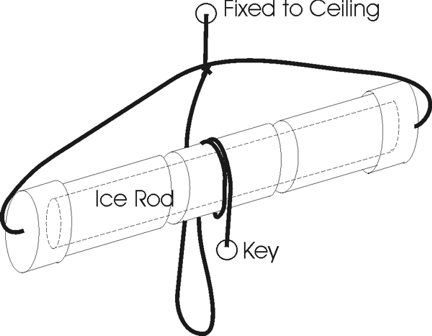
The idea described here avoids all of these problems. It is as close as I have seen to being perfect, with regard to meeting these requirements. The basic idea is to use a rod made of ice to hold three short pieces of tube together in line. When the ice melts, the centre piece can fall away from the others, allowing a key (or whatever) to drop. The delay depends on the diameter of the tubes (or more precisely of the rod). My experiments have been with a one-inch tube, which gives a delay of about two hours. 1.5" tube should be about three hours, and two inch tube should be about four hours, although you should test this yourself before depending on it. The ideal material is probably plastic water pipe, available in any hardware shop. (I actually used acrylic tube because I had some, but I think something more resilient would be better - see below). You'll need about 18" of tube, and also three caps that fit tightly over the ends. These are also fairly easy to get. You'll need a few yards of string, too. The description is a bit complicated, but the sketch below should help. Cut three short lengths of tube, about 2.5" seems right although it isn't critical, and one piece about 1/4" shorter than the combined length of the other three. The latter will be the mould for making the ice rod. Drill or punch holes in two of the caps, and pass a piece of string through the holes, knotting it on the inside. The string should be a couple of inches longer than the combined length of the three short pieces. I'll explain in a moment what this is for. To the middle of the string, tie another, long piece. One end should be tied in a loop to be hung from a beam, the ceiling or whatever, of a length such that the whole thing is held up out of reach. The other end is long enough to drop to the floor, or whatever height is required. The key (or whatever) is tied to the very end. Close to the end, it is looped around the middle tube and tied tightly, maybe even fixed in place with some glue.
Meanwhile, the third cap is pushed on one end of the longer tube. It's a good idea to wrap the tube round tightly with duct tape, so it doesn't crack. Fill it with water to within 1/4" or so of the top (remember that ice expands as it freezes) and place in the freezer until it has frozen. When you are ready to use the device, and when you have completed as much of the preparation for the session as you can, take the rod, in the mould, from the freezer. It's best just to leave it to stand for fifteen minutes, so it melts enough to slide out of the mould (self-bondage requires so much planning!). Alternatively you place it in warm water to speed things up, but this may crack the rod and make it unusable.
Push one of the strung-up caps over the end of one of the short tubes, and assemble the three tubes in line along the rod. Now push the other cap over the other end. Now, the three tubes are held together by the rod, and they can't slide off because of the caps, which are held close enough together by the string to stop them. Hang the whole thing up in some suitable place where you will be able to reach the key, after the centre tube drops. And that's it. Obviously you can make several of these, of different sizes and hence different release times. Personally I find two hours about right, but if you want to make things tougher for yourself just use bigger tube.
There are a couple of problems with making the ice rod. Because ice expands, the acrylic tube I used cracked, and broke after the second time - hence the duct tape. I think that vinyl tube, as used for water and drains, would have enough flexibility to avoid this. Of course you can always make another mould easily enough anyway - this kind of pipe generally comes in lengths enough to make quite a few of them. The other problem you may run into is that the ice rod can crack and even break as it is being removed from the mould. Heating it up to remove it from the mould causes quite a lot of thermal stress and interior cracking. One solution is to make several rods. Another is to leave the rod in the mould in the freezer for ten minutes or so after releasing it. This makes it weld itself back together, and seems to work most of the time.
Apart from these minor problems, which do not affect safety, this device seems to meet all the requirements and to be very easy both to construct and to use. Happy self bondage, and play safe!
Anton