


Back to The Girl with No Name
Forward by Master-Historian Maritza Ortskt-Dukovna
 Every
country has its legends; the stories of people whose lives have
transcended historical reality into that strange space between truth and
fantasy. The Grand Duchy of Upper Danubia (or the Danubian Republic, as
we prefer to call ourselves today) is certainly no exception to that
common trend throughout humanity. In our case we have the stories of the
Ancients, the Byzantine Priests who converted us, the exploits of King
Vladik the Defender and his son-in-law, and songs about the Nymphs who
defended the Duchy when almost all of its men had been killed.
Every
country has its legends; the stories of people whose lives have
transcended historical reality into that strange space between truth and
fantasy. The Grand Duchy of Upper Danubia (or the Danubian Republic, as
we prefer to call ourselves today) is certainly no exception to that
common trend throughout humanity. In our case we have the stories of the
Ancients, the Byzantine Priests who converted us, the exploits of King
Vladik the Defender and his son-in-law, and songs about the Nymphs who
defended the Duchy when almost all of its men had been killed.
However, Danubia's favorite story has always been the saga of "Bezimyackta",
commonly translated into English as "the
Girl-with-No-Name". "Bezimyackta" shows up in historical records starting around
1750, and seems to have completely disappeared around ten years later.
According to witnesses who claimed to have seen her, she was the
prettiest, smartest, and nicest young woman imaginable. However, she was
condemned to always be on the run, tormented by the Destroyer who
followed closely behind her. In earlier versions of the story, the
Destroyer, who at the time still was identified with the Christian
Beelzebub, had a semi-human form and rode on her shoulder. Later, the
story goes that she was running from the Destroyer. Because the
Destroyer could never quite catch her, the Destroyer's vengeance was
inflicted on anyone the Girl-with-No-Name tried to love.
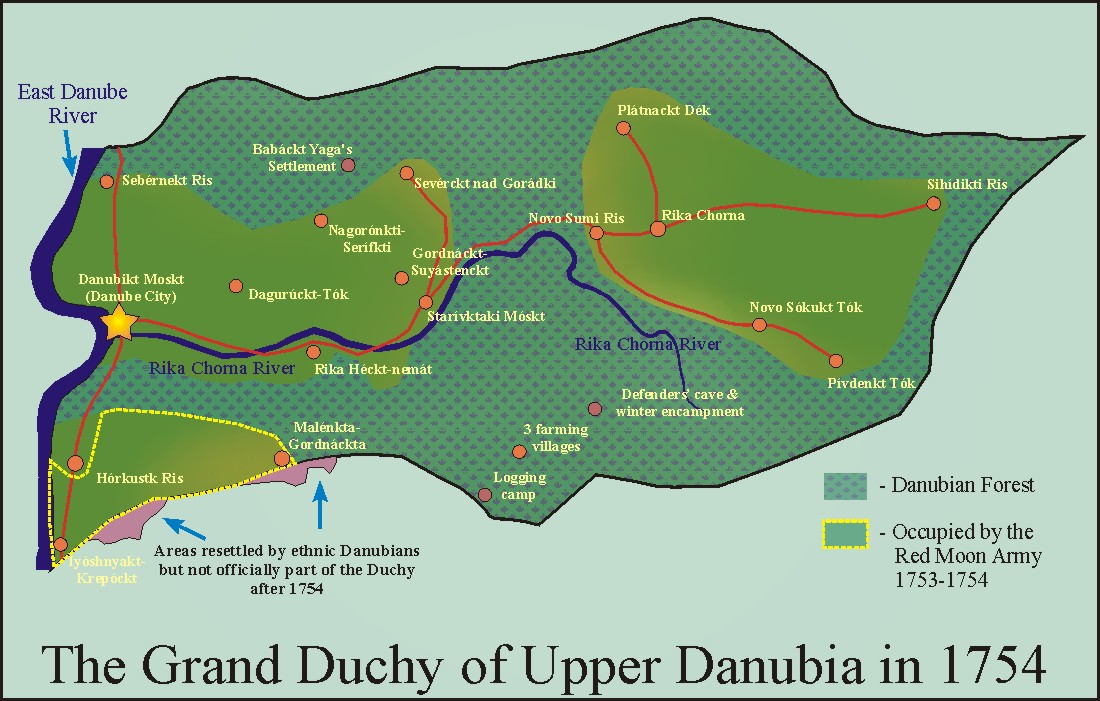
Bezimyackta's adventures began at her home in Rika Heckt-nemat.
The legend claims that she was so beautiful that the town's other women
couldn't bear to look at her, and demanded that the council's elders
order her executed. Bezimyackta made a pact with the Destroyer
to escape, and as soon as she was gone, the Destroyer condemned everyone
in the town to die from the plague. Bezimyackta ran from
province to province, trying to find love, protection, and peace. Many
men loved her, and all of them died tragically. When the
Girl-with-No-Name fled to Danubikt Moskt and the Grand Duke fell in love
with her, to punish the Duke, the Destroyer burnt the entire capitol.
In the end, no one knew what became of the "Girl-with-No-Name". For a
decade she wreaked havoc on the people who crossed her path and then
vanished without a trace. She became the favorite subject of campfire
songs and a story to scare children, especially boys and teenagers. I
think every mother in Danubia is guilty of telling her sons to avoid
strange women who seem too beautiful to be true, especially ones in the
woods or on the roads, because somewhere Bezimyackta continues
her tormented voyage.
In 1855, on the 100th anniversary of the Great Fire that destroyed the
nation's capital, the famous Danubian poet and song-writer Danguckt Tok
compiled the stories of Bezimyackta into a song, which,
although over-simplified, continues to be the best-known version of the
legend.
The girl condemned to wander
The anguish in her soul
Her Path in Life is destruction
The darkness rides her shoulder
In her eyes there's nothing but pain
She will reach out to you
Yes, you're the one who'll save her
But take her hand
and her kiss will seal your fate
The Destroyer holds out his bait
and for you, oblivion awaits
One important job of the historian is to attempt to reconstruct the
events that inspired a legend. Many historians will reject a legend on
impulse, only to later discover archeological or documentary evidence
that does indeed offer proof that events described in the story actually
did happen. I take a different approach, because I believe that most
legends are embellished truth, not pure fantasy. Those stories exist for
a reason: they were based on something that at one time was factual.
Therefore, we must start our investigation by taking these ancient
stories at face value and only dismiss details as we find direct
evidence that discredits them. Even when events turn out to not have
taken place as described by the chroniclers, we can use other research
to reconstruct what actually did happen and often end up with a
narrative that is considerably more interesting than the one given in a
simplified campfire song.
 Bezimyackta,
or "the Girl with No Name", always fascinated me. As is true for many defiant Danubian children, I remember several times going out into the forest
and looking for her, and receiving the switch for my efforts. As an
adult, I pursued plenty of "serious" historical research endeavors, but
in the back of my mind I always wanted to find the truth about the
Girl-with-No-Name. Whenever I looked at church records and personal
diaries for other projects, I always hoped to find some reference to
her.
Bezimyackta,
or "the Girl with No Name", always fascinated me. As is true for many defiant Danubian children, I remember several times going out into the forest
and looking for her, and receiving the switch for my efforts. As an
adult, I pursued plenty of "serious" historical research endeavors, but
in the back of my mind I always wanted to find the truth about the
Girl-with-No-Name. Whenever I looked at church records and personal
diaries for other projects, I always hoped to find some reference to
her.
My search narrowed when I read the diaries of a city councilman written
during the years immediately before plague struck down Rika
Heckt-nemat's population. One paragraph that fascinated me focused on
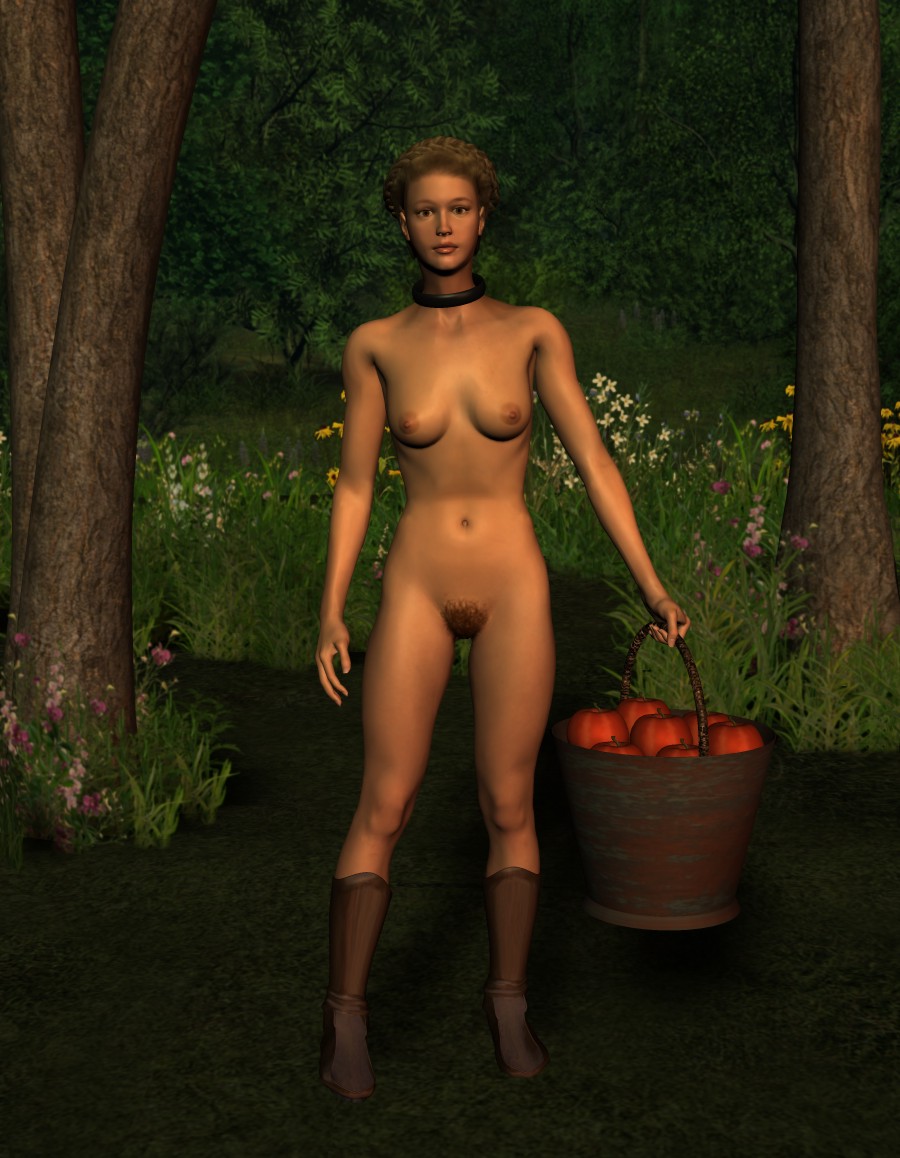
the punishment of a peasant girl called Danka Siluckt in the early
summer of 1750. He described her as unusually pretty for a peasant,
mentioned that she worked for him, and added that she was sentenced to
the pillory for stealing apples. She was then either expelled from the
town and fled, or thrown into the Rika Chorna by the city guards to
drown. The councilman complained that the mystery of the girl's
disappearance kept him up at night and troubled his conscience.
An account from the town priest for the same time period corroborated
the councilman's diary entry. The clergyman added that Danka Siluckt was
viciously mistreated by the townsfolk, especially the women, while she
was restrained on the pillory and that it was a shame to see such a
pretty girl treated in such a harsh manner. Surly the Lord-Creator would
punish the city for such an immoral act. Interestingly, the priest also
seemed unsure whether Danka Siluckt drowned in the Rika Chorna river or
somehow managed to escape the city.
So, with the vital assistance of two colleagues and three graduate students, I pursued that lead, suspecting that
"the Girl-with-No-Name" had
started out as the peasant Danka Siluckt. We followed clues around our
country, establishing a time-line of her travels and the events of her
life. The search was not easy, because Danka was forced to assume
different identities during her travels, but I am confident our team of
researchers accounted
for all of her ten years of wandering.
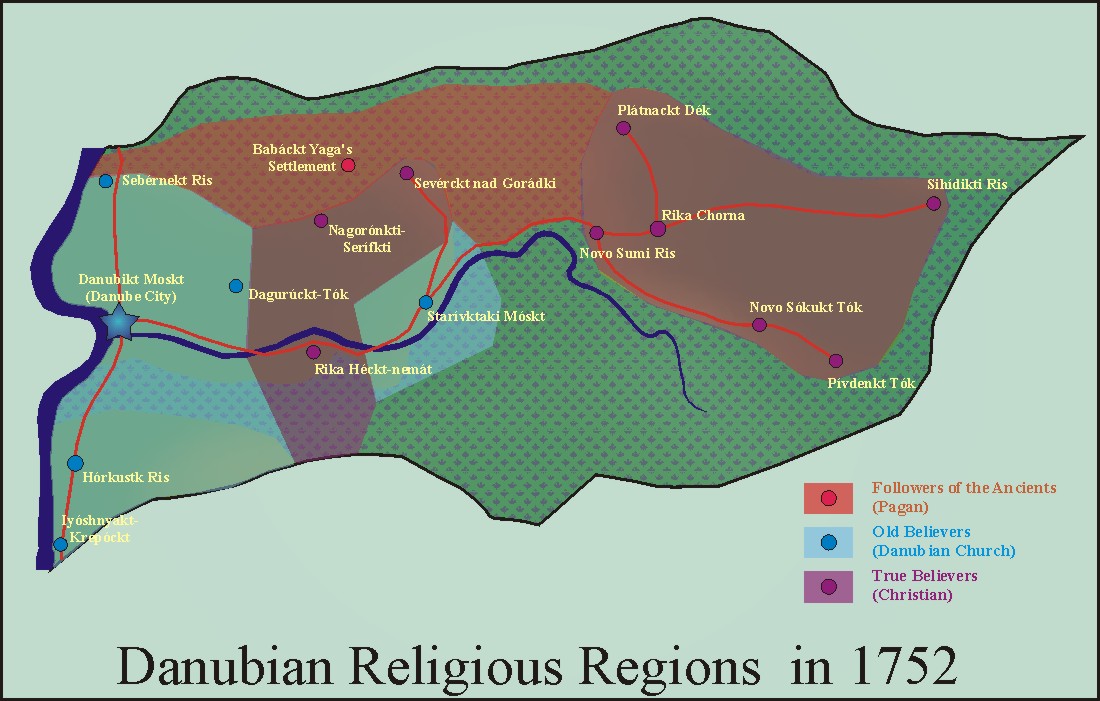
Our research took us to the Seminary in Starivktaki Moskt, the University
in Sebernekt Ris, the Vice-Duke's compound in eastern Danubia, and the
site of the True Believers' Convent in Novo Sokukt Tok, just to name a
few places we visited. We took it for granted Danka was in Danubikt Moskt
during the Great Fire of 1755, and found numerous references to a
concubine called "Sister Silvitya" in the diaries of the Grand Duke's
advisors, castle matrons, and song-writers. The most important clues we
found for that period of her life were in the memoirs of Mayor Alexandrekt Bulashckt, the founder of the southern town of
Malenkta-Gordnackta, in which he described his escape from the Great
Fire with his family and a woman who had been one of the Grand Duke's
mistresses.
My companions and I are also convinced we know where Danka Siluckt ended up, after having
read the diaries of the Orsktackt family, which they so graciously
shared with us. During his later years, the estate-owner kept a journal
of his city's progress and politics, while his second wife, Vesna
Roguskt-Orsktacktna, wrote extensively about the farm and the growing
Orsktackt family. She also wrote some lines about what Rika Heckt-nemat
was like before the plague, and other comments about various places she
had seen while traveling around the Duchy. Those entries convinced us,
more than anything else we researched, that Danka Siluckt, "Sister
Silvitya", Vesna Roguskt-Orsktacktna, and several unnamed women who
briefly appeared in other towns, were all the same person, who ended up
being known as the "Girl-with-No-Name".
So, years ago I started looking for Bezimyackta and, with the
help of my research team, I found
her. Danka Siluckt's story inspired us more than we can put into words.
She was not a tragic figure at all, but instead an incredible young
woman who overcame tremendous odds in a Duchy that was much harsher than
the comfortable country we live in today.
As I traced her footsteps, I felt I got to know Danka. She is part of me,
as she is part of everyone who is a citizen of Danubia. And, as best as I
could reconstruct it, this is her story.
Chapter 1
----------
Note01:
"
Bezimyackta
" is a
combination of the following words: Bez (without), imyackt (name), and
the ending "a" which identifies the subject as female. The literal
translation of "Bezimyackta" from Danubian to English would be: "She who
is without a name". The name "Bezimyackta" does not directly indicate
Danka was young, just that she was female.
"The Girl With No Name" English translation of "Bezimyackta" may not be
literal, but it most accurately describes the context of the stories
based on Danka's life and how Danubians remember her. The popular lore
describing her travels always portrayed "Bezimyackta" as being the age
of a young marriageable woman at the height of her beauty. During the
late eighteenth century, women typically married when they were 16-18
years old. Peasant women tended to marry about a year earlier, when they
were 15-16.
- Maritza Ortskt-Dukovna -