
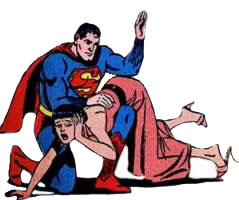
Q UITE A FEW YEARS AGO, back in the days when suits had vests and stockings had seams, spanking was the most universally accepted form of social discipline. For most kiddies, it was just another part of their everyday routine, as normal as a trip to the barber's or pot-roast on Sunday. Few children reached maturity without experiencing a 'licking' or two from an irate parent, and most were surrounded by not-so-subtle reminders of what might happen when they stepped out of line. The practice had entered the popular culture through every available medium, from the four-color press to cinema. Magazine advertisements were riddled with references to woodsheds, slippers and shaving straps; steely-eyed fathers administered stern beatings to unruly sons and wailing daughters.
Nor were the spankings confined only to children. As the nominal head of the household, the Man was traditionally responsible for maintaining discipline within the entire family - particularly those members of the feminine persuasion. Present-day observers would view this as a form of crude patriarchal oppression, but it's worth remembering that at the time, real men never struck women with a closed fist - at least not on film. From this perspective, a well-smacked bottom was the preferred option, particularly when sexual rivalries got out of hand. Consequently, marital disputes were settled with a firm hand and a sore bottom, petulant housewives firmly reminded of their place in the marriage and spoilt young socialites treated like naughty little girls.
Cinematic spanking scenes were usually played for laughs - a spanking is always funny if it's happening to someone else - but there was always a hint of eroticism behind the debutant's wilful manipulations. A spanking usually signaled the beginning of a serious romance; the logic being that a woman looks more favorably on a man once he demonstates that he won't put up with any devious shenannigans. Inevitably, Hollywood spanking scenarios were built on gender archetypes; the girls were always young, pretty and slightly willful - the kind of pampered little miss you could take home to your mother one night and over your knee the next. Likewise, the men had to epitomise all the masculine virtues of their day - tough but kind, firm but gentle, strong but good-natured.
The same rules applied in the funny papers.
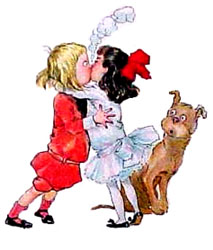
The modern comic strip first appeared in the mid-nineteeth century with the publication of The Adventures of Mr. Obadiah Oldbuck in 1837. As the artform was aimed at a general audience, spanking made its debut surprisingly early, being one the few thing that both adults and children could relate to. The first continuing character to feature regular corporal imagery was probably Richard F. Outcault's Buster Brown (New York Herald, 1902). Although Buster was depicted as an angelic (and rather effeminate) little boy, his devilish streak often landed him in trouble with his aristocratic mother, who would take to him with a slipper or hairbrush at the end of virtually every episode. Every so often, one of Buster's playmates would end up on the receiving end, and readers were treated to the sight of a young girl having her bottom firmly paddled - usually as the result of Buster's mischief.
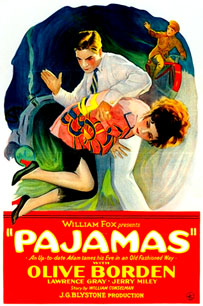
It wasn't long before adult spanking began to creep into the picture. A number of 1920s 'flapper' strips featured teenaged girls going over the parental knee for late nights and vampish behavior (a common enough situation during the roaring twenties, one might imagine). In other stories, wayward debutants pushed their fiances that one step too far, leading to a humiliating denouement for the title character. Cliff Sterrett's Polly, Chic Young's Dora and Larry Whittington's Fritzi Ritz all suffered the occasional love-swat from their long suffering boyfriends. Strips such as these were characterized by an emphasis on romance and gender conflicts (a clear parallel to recent developments in Hollywood, incidentally). However, despite the proliferation of 'modern-girl' comedies during the roaring twenties, spanking was still relegated mainly to the sphere of juvenile humor. It wasn't until the advent of adventure strips in the 1930s that girl-spanking became a regular event in the comics.
For some reason, the appearance of characters such as Jungle Jim, Barney Baxter or Agent X-9 opened the floodgates on romantic spanking (and not a little sado-masochism into the bargain). Partly, it had to do with the subject matter - action and adventure stories require well-defined gender rolls, so a certain degree of sexual stereotyping was inevitable. The image of a handsome, steely-eyed male taking his precocious young girlfriend across his lap reinforced comtemporary notions of masculinity. The action implied a certain loss of dignity for the heroine, but again, the idea was perfectly acceptable to prohibition-era audiences. True to their time, the women in these stories were spirited but feminine, invariably falling into a more passive role following a well-deserved spanking.
Another factor to consider is the artwork. Aimed primarily at a more mature demographic, adventure strips employed a more conscientious form of representation, one emphasizing realism over caricature. This illustrative style allowed greater scope for the depiction of adult situations, some of which included mildly sexual activities. Physical contact was necessarily minimal - this was the thirties after all - but spanking was considered at least as innocent (and normal) as a chastely passionate kiss. Illustrators were quick to seize upon the climactic potential of the spanking scene, and frequently went to great lengths to portray the tension and drama of the moment. It was during this period that many of the artistic conventions for the mainstream spanking genre were established - echoes of which can still be detected today.
Unfortunately, very few examples survive from this period - for every Dick Tracy, Flash Gordon or Prince Valiant that entered syndication, there were a dozen second-stringers who bit the dust after a couple of years. Mortality rates have always been high amongst newspaper strips, where circulation determines lifespan. There were, nonetheless, some notable exceptions; universally recognised characters which made the transition from the Sunday Supplement to the four color press, eventually receiving iconic status by the end of the twentieth century. In the next section, we will deal with the better-known examples, tracing their development from late thirties newspaper strip through to the Great Spanking Renaissance of the 1950s.
